
The Threshold
Guy-Wire Grief & Survival Counseling · online, for any faith or none · for those who have walked the dark too.
Credentials
Professional diploma and international certification in Grief and Bereavement. My work is not clinical, but includes complementary therapy and guidance.
It is late, most likely, and you have been reading pages that either felt like an intake form or asked you to believe something first. You do not have to be anything here yet. Not a client, not a case, not a person of faith or a person without one. Only someone awake, carrying something heavy, looking for a person who will sit with you and not rush you.
My name is Henry-Cameron Allen. I offer online grief counseling to people anywhere, and I call the people I sit with Griefwalkers, because there are as many ways to carry grief as there are people carrying it. What I offer is not the clinical kind of help, and I will be plain about that difference in a moment, because it matters. What I offer is company, precise and unhurried, for the part of grief that no one can walk for you.
Yes, it is online. Yes, it is open to you.
Every session happens by video, which means the distance between us is not the thing that decides whether you can be met. Spain, the United States, wherever you are reading this, the door is the same door.
And it is open to any faith, or none. I am ordained interfaith clergy, a rabbi in one tradition and a Spiritual Humanist minister in another, and I have sat with committed atheists and lifelong believers in the same week, each met at the same level: not their theology, but what they are actually carrying. My temple is nature. My congregation is all of us. You do not need to share my beliefs, or hold any, to sit down across from me. You only need to be carrying something you would rather not carry entirely alone.
My practice is rooted in Spiritual Humanism · seeing and serving the Creator in humanity, through the lens of ethics and reason. I am also ordained as a Rev. Rabbi in the tradition of Terran Judaism, a path that transcends any single belief system.
Grief Cosmologist
I am a Grief Cosmologist. Grief Cosmology℠ begins from one principle: nothing real ever ends. Energy is never destroyed. It only changes form. That much is physics, the floor I start from. What that continuing energy carries, I hold from my own tradition, not from the equation: the people we love do not vanish at the threshold we call crossing. The bond we carry with them changes form, and continues.
My work studies the laws of that continuing: how a being begins in light and goes on in light, how love is conserved rather than spent, how the one grieving and the grief itself are both alive and moving together. I do not manage your grief or march you through stages toward some exit. I show you the country you are already standing in, I hold the lamp while your eyes adjust, and I steady you until you can stand in it on your own.
What Is a Psychagogue?
Psychagogue. SY-kuh-gog. From the Greek psychē, soul, and agōgos, one who leads. Soul-leading. It is a very old word and it has been sitting in a drawer for roughly two thousand years.
I use it because nothing else available is accurate. Counselor imports the clinic, and this work is not clinical. Coach imports performance, and there is nothing here to improve. Guide imports a route, and a route is the one thing I will not offer, because the person carrying this already knows terrain I have never walked. Psychagogue means walking beside someone through the country of their own soul without claiming to have mapped it. That is the actual job.
Where it comes from. In Plato's Phaedrus, rhetoric is called psychagōgia, the leading of souls through speech. In the Greek and Roman philosophical schools that followed, the word settled around the care of the soul itself: the long, unhurried practice of bringing a life into alignment with what that life actually holds true. Scholars who read that tradition closely, Hadot and Foucault among them, describe it as lived practice rather than doctrine. Reading it as an ancestor of modern psychotherapy is an interpretation and I offer it as one. What is not in question is the shape: someone sat with someone else, over time, and attended to their soul, and that happened for centuries before anyone thought to call it treatment.
What I am not saying. The oldest use of this word named a conductor of souls across into the underworld, and sometimes a necromancer who called them back out. I am not doing that and I want no ambiguity about it. I do not contact anyone who has crossed, I do not carry messages, and I do not claim access to anything on the other side of a threshold I have not crossed myself. What continues, continues without my assistance. I walk the living to the threshold and back again. That is the whole of the direction, and the direction is the difference.
What I am also not saying. The word survives in modern usage to mean a persuasive person, someone whose rhetoric reaches soul-deep. I decline that meaning entirely. Persuasion is the opposite of this work. A psychagogue who persuades has stopped walking beside and started walking in front, and the person following has lost the one thing that was theirs.
Three levels, and the body first. Grief is not only a thought about what changed. It arrives in the body before it reaches language, and it goes on living in whatever a person holds sacred long after the language runs out. So the work moves across all three.
The body, because it is where this lands first and where it stays longest. The mind, because meaning has to be rebuilt and that is thinking work. And the spirit, whatever a person means by that word, including nothing, because for most people something in their architecture of meaning has shifted and nobody has helped them look at it.
The body is the part that is genuinely new here. The ancient psychagogue had no somatic practice, and modern psychotherapy largely handed the body to medicine and walked away from it. Putting it back is not a flourish. It is the correction.
My Method
A guy-wire is a stable cable that helps steady a freestanding structure until it can stand securely on its own. That is what I offer: not someone to carry you, but someone to hold steady alongside you while you find your footing again.
My approach integrates three elements:
- Guy-Wire stabilization · steady, consistent support during life's disruptions
- Formwork · rebuilding the foundational structures that grief can dissolve
- Deep Organ Therapy℠ (DOT) · aligning brain, heart, and gut to move from overwhelm to orientation
I bring personal experience to this work. My son Cameron was diagnosed with brain cancer at eleven and crossed at thirteen, in 2008. It took his body, not him. He remains the clearest intelligence behind everything I do. I know what it is to stand at the threshold between who you were and who you must become. I have walked the dark too · and I know the way back toward the light.
What a first session is actually like
Most people arrive bracing for the version they have seen before: a form to fill out, questions that sort them into a category, a plan handed over at the end like a prescription. That is not what happens here. A first session is quieter, and simpler, than the fear of it.
- We begin with the free fifteen minutes, so you can hear my voice and feel whether this is right before anything is decided. No pressure sits on that quarter hour.
- You talk. I listen. There is no assessment running underneath, no diagnosis being quietly assembled while you speak.
- We start wherever you already are, not at some official beginning. If today is a hard day, that is the session. If today you can only manage silence for a while, that is allowed too.
- You set the pace and you keep the reins. You decide what to name and what to hold back. Nothing is required of you, not even that you say the hardest thing today.
- You leave with one small thing to carry, if you want it. Never homework. Never an assignment. Just a single steadying line or practice, offered, not imposed.
That is the whole shape of it. A conversation with someone who has done this at close range for eighteen years, and who will not hurry you toward a version of yourself that fits anyone else's timeline.
How this sits beside clinical grief therapy
I want to be careful here, because the honesty of it is part of the care. I am not a state-licensed clinician. I do not diagnose, and I do not provide medical or psychiatric treatment. If what you need is clinical care, that work is real, it is good, and I will help you find it rather than pretend I am it.
A psychagogue walks alongside. Holds a lamp, not a map. Trusts that you already carry your own intelligence about what you are moving through, and works to witness it rather than redirect it. Clinical therapy asks how to help you function again, and answers it well. This work asks a different question, about what is actually true where your person, or your old life, or your old self, has gone. Those are not competing answers. They are different instruments, and many Griefwalkers carry both. If you are already seeing a therapist, this sits beside that, it does not replace it.
Who I Work With
I work with individuals, couples, and families, and with grief in many shapes: a parent whose child has crossed, a partner, the slow grief of a life that changed course, the grief that has no funeral because no one died and something still ended. I work often with men, who are frequently handed silence instead of language for any of this. I hold sessions for youth as well, through LEAP youth mentoring, ages nine to fifteen.
The framework underneath all of it is one I have spent years building, and you are welcome to read it in full. It is called Grief Cosmology℠, and it begins from one plain claim: nothing about what you carry is broken.
Men
Grief, identity, anger, purpose, fatherhood, moral injury, andropause, complex guilt & forgiveness.
Women
Grief, caregiving, life transitions, complex guilt & forgiveness.
Couples & Families
Healthy communication, conflict repair, meaning-making rituals, forgiveness & amends work.
Youth (ages 9–15)
Age-appropriate coping skills, emotional literacy, caregiver partnering, life skills mentoring.
LEAP · Youth Mentoring
Life Evolving Adaptive Potential · personalized universal life skills for ages 9–15. Creative, embodied mentoring for young people carrying grief, transition, or simply the work of growing up. Sessions are virtual and tailored to each child, with parents and caregivers part of the work, building adaptability, communication, emotional intelligence, problem-solving, self-expression, and resilience.
Explore LEAP · free 30-min consultationCore Principles
- Compassionate support in a non-judgmental environment
- Individualized care · grief takes the shape of the person carrying it
- Lasting tools · resilience-building practices you carry forward
- The whole person · physical, emotional, cognitive, and spiritual wellbeing
- Collaboration · I am your partner, not your authority
Starting, when you are ready
There is no wrong time to begin, and no obligation created by beginning. Start with the free fifteen minutes if you want to feel it out first. Book a full session if you already know. Sessions are priced to be reachable, and proceeds support The Lost Travelers Club, so the work makes more of itself.
The first hour is $85, with a 60-minute minimum. Additional time beyond the first hour is billed at $1 per minute.
My work lives outside the clinic. I am not state-licensed, do not diagnose, and do not provide medical or psychiatric care. This is complementary therapy and relational counseling. It should not be a substitute for clinical or crisis mental health services. In a crisis, please dial or text 988 (USA) or contact your local emergency services. Thank you.
And if you have read this far and will not book, because it is 4am, or because it is out of reach right now, take this with you anyway, freely: the grief you are carrying is not a sickness, and it was never a disorder to be cured. It is the shape love takes when it has nowhere left to be put down. You are not doing it wrong. Always here. A little ahead.
Rev. Rabbi Henry-Cameron Allen, OCP, ICGC
Gift Cards
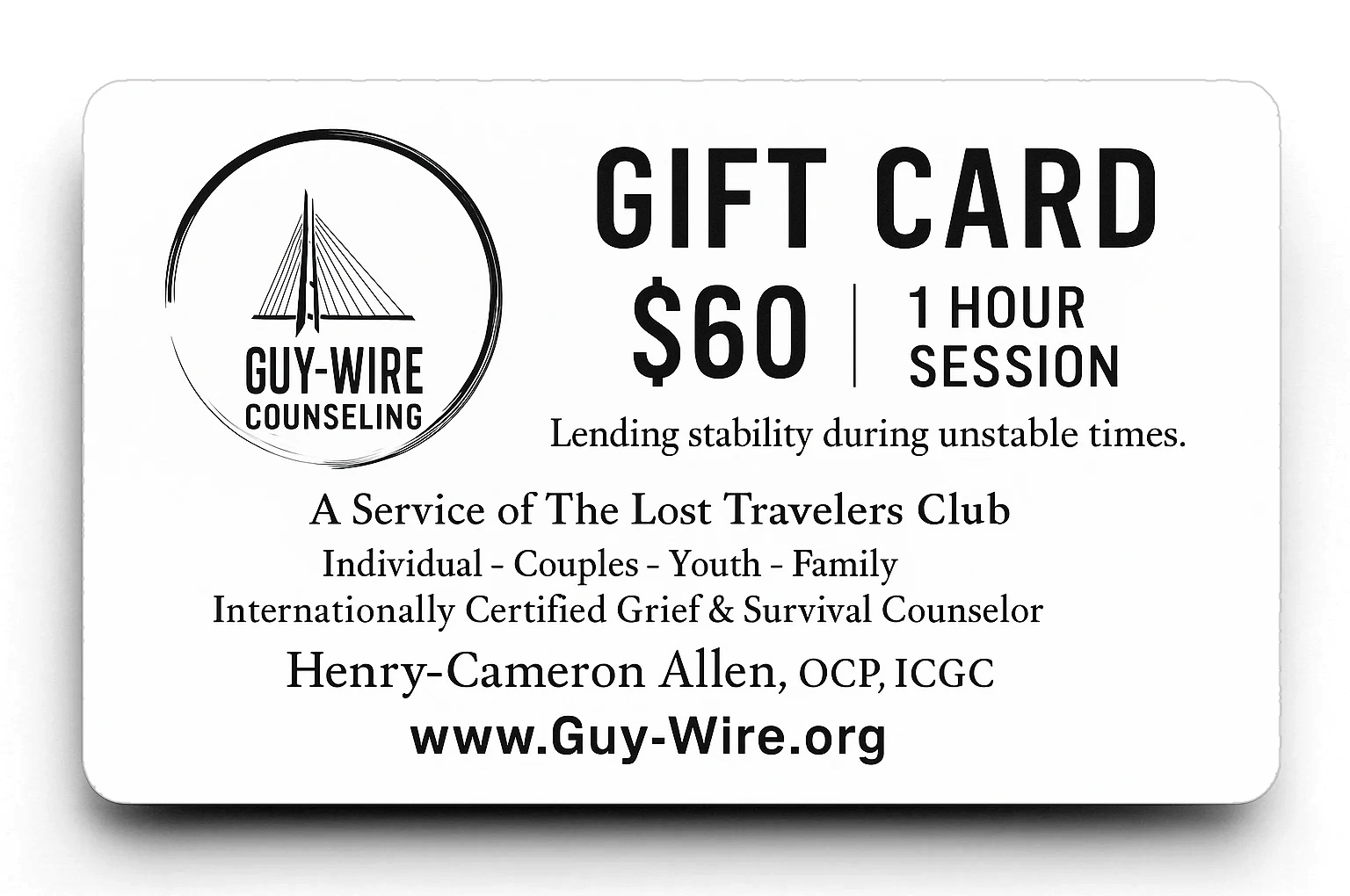
Give someone a first session. A $60 gift card covers one full 60-minute session, usually $85: nearly 30% off. It is good for a first session only, and arrives by email with its own code.
Voices from the Threshold
"Henry is one of the kindest, most compassionate and passionate people."Cindy Curcio, Educator & Entrepreneur Read in full →
"Heart-centered, loving, trusting, and present · his work benefits adults, teens, and children alike."Keri Ellis Cahill, Founder, Rebel Shakespeare Company Read in full →
"You were throwing me a lifeline."Dr. Jody Jakob, DO, Portugal Read in full →
"Working with Henry has helped me to evolve far beyond what I initially expected."Rodolfo Nieto, Singer, Actor & Former Caregiver Read in full →
Frequently Asked
Do you offer online grief counseling?
Yes. All sessions are online, so where you live does not decide whether you can be met. We meet by video, and the first fifteen minutes are free, with no expectation that you continue.
Is there grief counseling for people who are not religious?
Yes. This work is open to any faith or none. I am ordained clergy, and I do not require you to share my beliefs, or hold any, to sit with me. Atheists, agnostics, the devout, and the unsure are all met the same way, at the level of what you are actually carrying.
What is a psychagogue?
A psychagogue (SY-kuh-gog) walks beside a person through what grief changes, carrying a lamp rather than a map. The full definition is above.
What is the difference between grief counseling and grief therapy?
Clinical grief therapy is licensed care that can diagnose and treat, and it does necessary work I refer people toward when that is what is needed. What I offer is companionship, not treatment. I do not diagnose or prescribe a pathway. I walk alongside you as a psychagogue, an old word for a soul-guide who holds a lamp rather than a map. The two sit beside each other. Many people carry both.
What happens in a first grief counseling session?
You talk and I listen. There is no intake form to complete before you are seen, no assessment, and no plan handed to you at the end. We begin wherever you already are. You set the pace, you decide what to name and what to keep, and you leave with one small thing to carry if you want it, never an assignment.
How much does online grief counseling cost?
The first fifteen minutes are free. Sessions are priced to be reachable: the first hour is 85 US dollars with a sixty-minute minimum, and any time beyond the first hour is one US dollar per minute. Proceeds support The Lost Travelers Club.